


I am introducing Bitcoin Roots, a full-node project I’ll maintain as part of my work as Scientific Director for the Plan ₿ Foundation in Lugano. With this project I intend to carry forward selected conservative policy and operator controls from Bitcoin Knots, with a commitment to produce a versioned patch applicable to Bitcoin Core. Bitcoin Roots will be a built application derived from such an inspectable patch applied on every major release of Bitcoin Core and will always be compatible with its consensus rules.
I am a long-time user and a big fan of Bitcoin Knots. Its attention to the needs of node operators suited the way I run my own machines. I value being able to limit resource consumption and choose which transactions my node relays.
Knots has served me well, and I remain grateful to Luke Dashjr and the other contributors. My disagreement with its recent direction does not erase that appreciation.
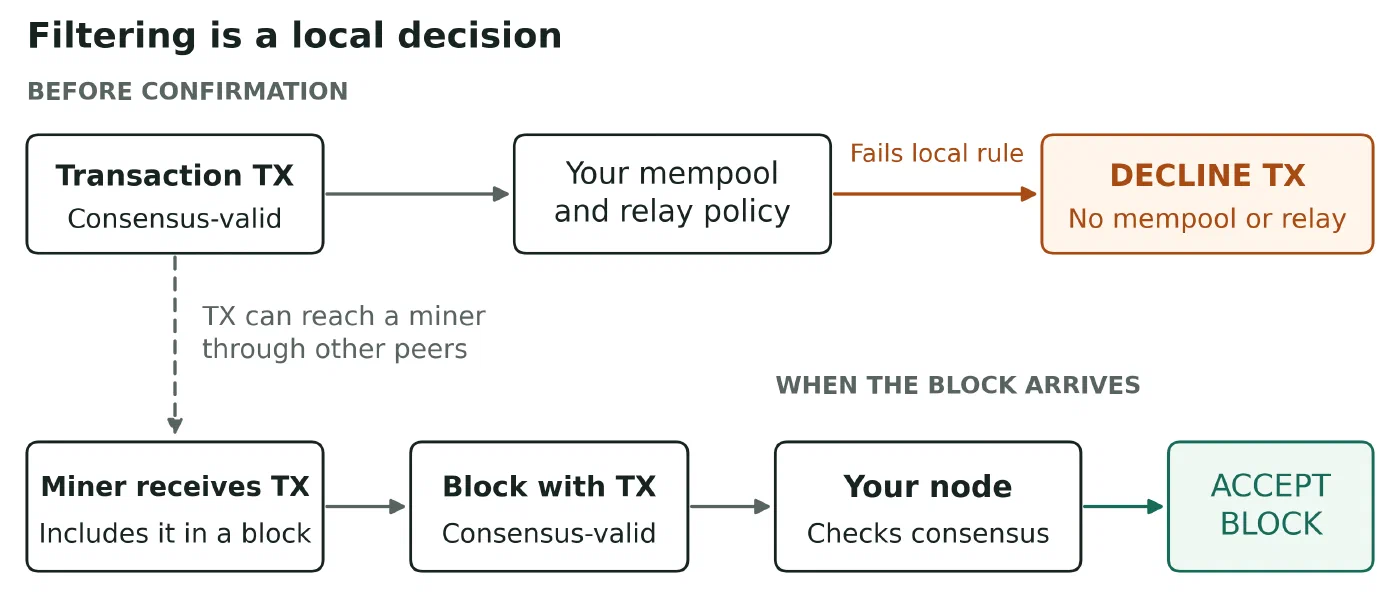
Filtering is a local decision
The cost of running a node is a real concern. More bandwidth, storage and processing power make independent verification less accessible. As an old-timer in Bitcoin, I still consider keeping it practical to run at home one of the project’s objectives. I understand the objection to using Bitcoin for arbitrary data storage: transaction fees pay miners, while node operators bear their own costs.
For me, that objection justifies choosing what my node relays and stores in its mempool, the local collection of unconfirmed transactions. If a miner includes a transaction in a block that meets Bitcoin’s consensus rules, my node should still accept that block. I can decide which transactions my machine handles before confirmation without requiring everyone else to share my preferences.
Where policy becomes consensus
BIP-110, the Reduced Data Temporary Softfork or RDTS, takes the objection further by proposing temporary consensus restrictions on transaction data and scripts. These rules are mechanically defined, but adopting them means deciding which uses of Bitcoin should remain possible. I do not think the case for those restrictions has been made.
Local filters cannot guarantee that unwanted transactions stay out of the blockchain. Trying to achieve that through consensus restrictions means rejecting some blocks that other Bitcoin nodes would accept. If miners continue building on both sides, the disagreement can become a lasting chain split, with two competing coins. That outcome depends on mining support and economic adoption, not simply on which side has more nodes.
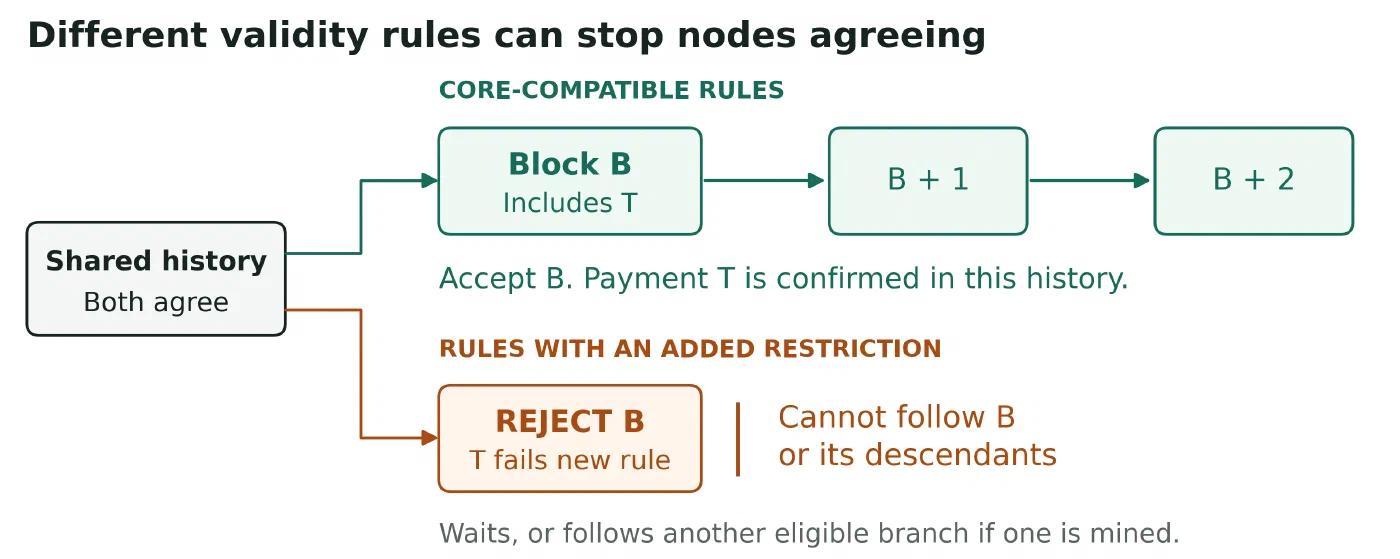
BIP-110 goes beyond local filters by restricting script features and how transactions can be constructed. The proposal acknowledges trade-offs for some advanced uses, affecting which funds people can spend and under what conditions. Changes of this kind deserve exceptional scrutiny and broad agreement on their benefits: an unwanted chain split would weaken the entire Bitcoin ecosystem. Reaching that agreement is a political process. It takes time, serious effort to consider every point of view, and close attention to technical detail.
Why I am leaving Knots
While this dispute remains unresolved, the recent Knots 29.4.1 release notes describe a backward-incompatible protocol change: replacing Bitcoin’s proof-of-work hash function with BLAKE2b and changing the block-weight limit. These changes go beyond both BIP-110 and local policy. Introducing them into one of the most widely used Bitcoin full-node implementations, during an already delicate debate, raises further concerns about maintaining shared consensus.
This is where I stop following Knots. I want to preserve useful operator controls while continuing to validate Bitcoin on the same terms as Bitcoin Core.
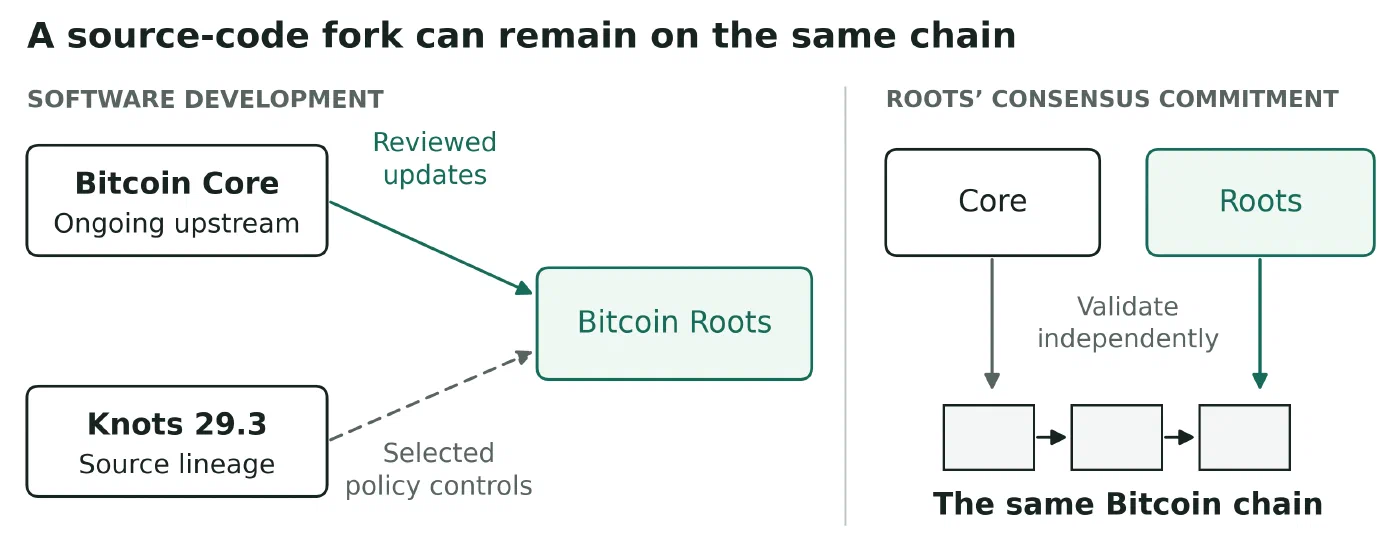
Bitcoin Roots is a source-code fork from the Knots 29.3 lineage. It does not enforce RDTS/BIP-110 or adopt the later Knots protocol changes. It continues on the Bitcoin network, without introducing a token or promoting a separate chain.
Bitcoin Core will remain our upstream. This commitment defines the scope of Roots: follow Core’s development, review and integrate suitable updates, and preserve consensus compatibility. Our differences should stay small enough to understand and maintain. I want improvements that can be contributed back to reach upstream whenever they fit.
I can disagree with a Core policy default while respecting the work and review behind the codebase. Keeping Core upstream means working within that shared development effort, with room for local choices and responsibility for every difference we carry.
Keeping Core as the trunk
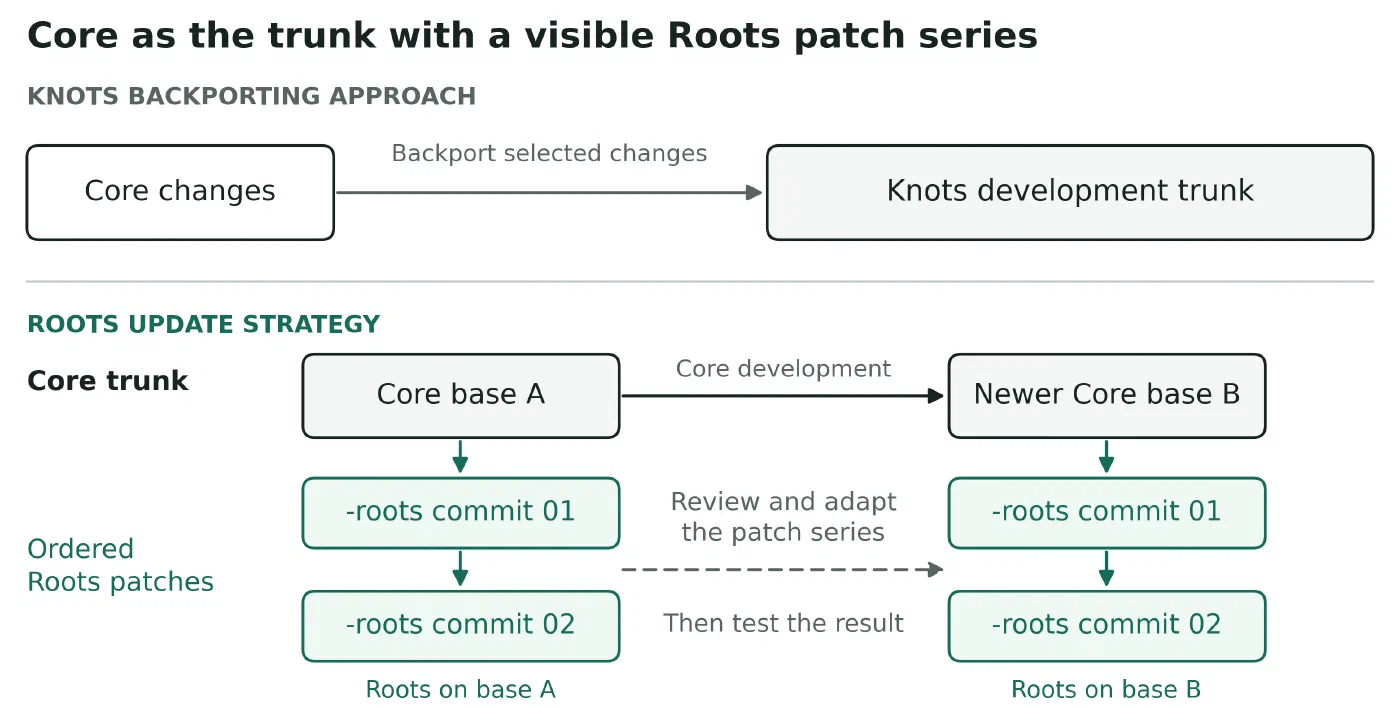
Our update strategy will also differ from Knots. Knots backported Core changes into its own development trunk. We will use Core as our trunk and apply the -roots patches on top, in an explicit sequence of commits that can be reviewed in order.
Each Roots release will identify its Core base, whether a release or a specific commit, and explain the purpose of each patch. When updating that base, we will review and adapt the patches, resolve conflicts and test the result. Patches accepted upstream or no longer needed will be dropped.
Anyone reviewing Roots should be able to see exactly what we add to Core, why we add it and why we still need it.
Operator control and reproducible releases
For me, user experience includes protecting the node’s resources. A node that demands more than its operator can spare will eventually be switched off. Clear limits and predictable behaviour matter. Roots retains selected Knots controls for this purpose, with policy documentation that explains their limits. These controls govern which unconfirmed transactions the node accepts into its mempool and relays. They do not change the rules for validating transactions included in blocks.
Binary releases also deserve attention. Bitcoin Core’s reproducible builds provide a foundation for pursuing the same goal in Roots. Our release organisation makes packages easier to identify, with consistent platform and architecture names based on uname. Archives extract into versioned directories, keeping their contents together and clearly identified. Release tags use the upstream Core version followed by -root.#, where # identifies the Roots patch revision for that release. The build configuration includes the graphical interface for Linux, Windows and macOS, and the release workflow prepares a signed checksum manifest so users can verify downloads against the signer’s checksums.
The work begins
My work on Dyne.org software and Devuan GNU/Linux has taught me that useful software requires sustained work long after the initial idea. Bitcoin Roots is just beginning. I am not claiming it is the best full-node software available: the code must earn your trust through review and use. I will work alongside Giacomo Zucco, S₿AM and the people at Lugano’s Plan ₿ Foundation to keep Roots minimal, reliable and interoperable for anyone who wants to run a local Bitcoin node, including myself.
The source is open and the first downloads are released starting with two versions based on Bitcoin Core 29.x. The 30 and 31 based patches will come soon enough. If you run a node, tell us what makes it difficult to configure or maintain. If you review code, examine what Roots changes in Bitcoin Core, especially where local policy meets consensus validation. I welcome criticism that helps us get the software right.
And come and say hello at the Plan ₿ Forum in Lugano on 23 and 24 October 2026. I will be glad to discuss Bitcoin Roots and the other developments taking place here. Early-bird tickets may still be available, so have a look at the ticket page. Bring your questions and disagreements. I look forward to talking in person.
See you in Lugano :^)